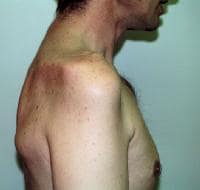
Showing posts with label Brachial Neuritis. Show all posts

MRI Results

Posted on 2:41 PM by Tweedle Beetle Tri-Athletle | 5 comments

OK... I DID IT!!!!

Through focused meditation and visualization... oh and 2 Percocet, 500 mg Naprocin and a muscle relaxer - I was able to grit through 20 min of real pain.  The meds took a bit of the edge off but it still really sucked.  The good news is that we got good images which at this point confirm that this IS NOT BRACHIAL NEURITIS!!! Unfortunately, it is not my imagination either :).  It looks to be a herniated disk and by the looks of it a "huge one".  I quote an orthopedic surgeon who is a family member of mine.

Here are the MRI images:

Photo 1

Photo2
 
 Photo 3:


Both photo 2 and 3 show the tell tale signs of a herniated disk and I guess it is fairly large which does correspond to the fairly large amount of pain I have been feeling!

Here is what I have learned thus far about Cervical Radiculopathy (Herniated disk)...

All of the information below was accessed from (http://www.spine-health.com and was written by:

By: Richard Staehler, MD)

Arm pain from a cervical herniated disc is one of the more common cervical spine conditions treated by spine specialists. It usually develops in the 30 - 50 year old age group. Although a cervical herniated disc may originate from some sort of trauma or injury to the cervical spine, the symptoms, including arm pain, commonly start spontaneously.
The arm pain from a cervical herniated disc results because the herniated disc material “pinches” or presses on a cervical nerve, causing pain to radiate along the nerve pathway down the arm. Along with the arm pain, numbness and tingling can be present down the arm and into the fingertips. Muscle weakness may also be present due to a cervical herniated disc.


Fig. 1: Disc herniation of the cervical spine
The two most common levels in the cervical spine to herniate are the C5 - C6 level (cervical 5 and cervical 6) and the C6 -C7 level. The next most common is the C4 - C5 level, and rarely the C7 - T1 level may herniate.
The nerve that is affected by the cervical disc herniation is the one exiting the spine at that level, so at the C5-C6 level it is the C6 nerve root that is affected.

Symptoms of a Cervical Herniated Disc

A cervical herniated disc will typically cause pain patterns and neurological deficits as follows:

C6 - C7 (C7 nerve root) - Can cause weakness in the triceps (muscles in the back of the upper arm and extending to the forearm) and the finger extensor muscles. Numbness and tingling along with pain can radiate down the triceps and into the middle finger. This is also one of the most common levels for a cervical disc herniation (see Figure 1).

  It is important to note that the above list comprises typical pain patterns associated with a cervical disc herniation, but they are not absolute. Some people are simply wired up differently than others, and therefore their arm pain and other symptoms will be different.
Since there is not a lot of disc material between the vertebral bodies in the cervical spine, the discs are usually not very large. However, the space available for the nerves is also not that great, which means that even a small cervical disc herniation may impinge on the nerve and cause significant pain. The arm pain is usually most severe as the nerve first becomes pinched.

Treatments for a Cervical Herniated Disc

The majority of the time, the arm pain from a cervical herniated disc can be controlled with medication, and conservative (non-surgical) treatments alone are enough to resolve the condition.
Once the arm pain does start to improve it is unlikely to return, although it may take longer for the weakness and numbness/tingling to improve. If the arm pain gets better it is acceptable to continue with conservative treatment, as there really is no literature that supports the theory that surgery for cervical disc herniation helps the nerve root heal quicker.
All treatments for a cervical herniated disc are essentially designed to help resolve the arm pain, and usually the weakness and numbness/tingling will resolve with time.

First line of treatment for a cervical herniated disc

When the initial pain from a cervical herniated disc hits, anti-inflammatory medications (NSAIDs) such as ibuprofen (e.g. Advil, Nuprin, Motrin) or COX-2 inhibitors (e.g. Celebrex) can help reduce the pain.
The pain caused by a cervical herniated disc is caused by a combination of:
  1. pinching of the nerve root, and;
  2. inflammation associated with the disc material itself.
  3. Therefore, taking anti-inflammatory medications to remove some of the inflammation can reduce this component of the pain while the pressure component (pinching of the nerve root) resolves.
For patients with severe pain from a herniated disc, oral steroids (such as Predisone or a Medrol Dose Pak) may give even better pain relief. However, these medications can only be used for a short period of time (one week).

Additional conservative treatment options for a cervical herniated disc

In addition to anti-inflammatory medications, there are a number of non-surgical treatment options that can help alleviate the pain from a cervical herniated disk, such as:
  • Physical therapy and exercise. Just as in the lumbar spine, Mckenzie exercises can be used to help reduce the pain in the arm. In the initial period a physical therapist may also opt to use modalities, such as heat/ice or ultrasound, to help reduce muscle spasm.
  • Cervical traction. Traction on the head can help reduce pressure over the nerve root. It does not work for everyone but is easy to do, and if effective the patient can use a home traction device for pain from a cervical herniated disc.
  • Chiropractic manipulation. Gentle manipulation can help reduce the joint dysfunction that may be an added component of the pain. High velocity manipulations should be avoided as they can make the pain worse, or worsen any neurological damage.
  • Osteopathic medicine. Osteopathic manipulation and special techniques to restore normal joint motion can be helpful in reducing pain from a cervical herniated disc.
  • Activity modification. Some types of activities may tend to exacerbate the herniated disc pain and it is reasonable to avoid these activities to keep from irritating the nerve root. Such activities may include heavy lifting (over 50 pounds), activities that can cause increased vibration and compression to the cervical spine (boating, snowmobile riding, running, etc.), and overhead activities that require prolonged neck extension and/or rotation.
  • Bracing. In some instances a cervical collar or brace may be recommended to help provide some rest for the cervical spine.
  • Medications. In addition to the anti-inflammatory medications mentioned above, narcotic agents (pain killers) might be used on a temporary basis to help reduce the pain and discomfort from a cervical herniated disc. Also, muscle relaxants or certain anti-depressants may help reduce the nerve-type pain (neuropathic pain) and help restore normal sleep patterns.
  • Injections. Epidural steroid injections or selective nerve root blocks can be helpful to reduce inflammation in cases of severe pain from a cervical herniated disc, and can be very effective if accompanied by a comprehensive rehabilitation program that may involve a number of the above conservative treatments.
Physicians who provide the above treatments for a cervical herniated disc may include family practitioners, physiatrists (physical medicine and rehabilitation physicians), osteopathic physicians, neurologists, and orthopedic spine surgeons or neurosurgeons. Chiropractors and physical therapists may also provide some of the above treatments for a cervical herniated disc in their respective areas of specialization.


Spine Surgery for a Cervical Herniated Disc


Bone graft
Fig. 2: Bone graft

Titanium plate and screw device
Fig 3:
Titanium plate and screw device

Most episodes of arm pain due to a cervical herniated disc will resolve over a period of weeks to a couple of months. However, if the pain lasts longer than 6 to 12 weeks, or if the pain and disability is severe, spine surgery may be a reasonable option.
Spine surgery for a cervical herniated disc is generally very reliable and can be done with a minimal amount of postoperative pain and morbidity (unwanted aftereffects).
With an experienced spine surgeon, the back surgery should carry a low risk of failure or complications. The success rate for back surgery for a cervical herniated disc is about 95 to 98% in terms of providing relief of arm pain.


The spine surgery for a cervical herniated disc can be done a number of different ways:
  • Anterior cervical discectomy and spine fusion. This is by far the most commonly preferred method among spine surgeons for most cervical herniated discs. In this surgery, the disc is removed through a small one-inch incision in the front of the neck.
  • After removing the disc, the disc space itself is fused (see Figure 2). A plate can be added in front of the graft for added stability and possibly a better fusion rate (see Figure 3). For more information, see Anterior cervical decompression (discectomy) back surgery
  • Anterior discectomy without spine fusion. This is basically the same procedure as above except after removing the disc the space is left open and no bone is added to get a fusion. The disc space will still often fuse even without a bone graft but the healing seems to be longer and when and if it does heal, it tends to heal in a deformed position.
    For more information, see Anterior cervical decompression (discectomy) back surgery
  • Posterior cervical discectomy. This is similar to a posterior (from the back) lumbar discectomy, and for discs that occur laterally out in the neural foramen (the “tunnel” that the nerve travels through to exit the spinal canal) it is often a reasonable approach. However, it is technically more difficult than an anterior approach because there are a lot of veins in this area that can result in a lot of bleeding, and the bleeding limits visualization during the surgery. This approach also necessitates more manipulation to the spinal cord.

    For more information, see Posterior cervical decompression (microdiscectomy) surgery

Potential risks and complications of spine surgery for a cervical herniated disc

Although any major surgery has possible risks and complications, with an experienced spine surgeon serious complications from cervical disc surgery should be rare.
Possible complications from spine surgery for a herniated disc include:
  • Damage to either the trachea/esophagus or one of the major blood vessels in the anterior spine (front of the neck). This should happen in less than 1 in 1,000 cases.
  • In about 1% of cases, retraction on the nerve to the voice box (recurrent laryngeal nerve) can cause hoarseness. The hoarseness usually resolves in two to three months.
  • Fusion rates run about 95%. Occasionally, there may be a postoperative nonunion that requires a re-fusion. Without a cervical plate there is a possibility (less than 1%) that the anterior bone graft will displace.
  • With either the anterior or posterior approach there is a 1 in 10,000 chance that there would be either nerve root or spinal cord damage.
  • Infection or cerebrospinal fluid leak happens less than 1% of the time.

Postoperative Care Following Spine Surgery for a Cervical Herniated Disc

For anterior surgery, there usually is not a great deal of postoperative pain. The surgery is done through a small incision in the front of the neck, and the spine can be accessed in between tissue planes that do not require cutting. This type of surgery usually can be done either outpatient (going home the same day as surgery) or with one overnight stay in the hospital.
The pain in the arm usually goes away fairly quickly, although it may take weeks to months for the arm weakness and numbness to subside. It is not uncommon to have some neck pain for a while.
Postoperatively, most spine surgeons prescribe a neck brace, although the type of brace and length of usage is variable. Also, most spine surgeons will ask their patients to limit their activities postoperatively, although the amount of restrictions and the length of time tend to vary. Ask your spine surgeon before the surgery what his or her usual protocol is regarding postoperative care.


Ya, lots and lots and lots of information, I know.  Anyway, I hope this blog can be a resorce for others going through this.  I will hear specifically from my doctor tomorrow and I will be seeking other opinions - I will fill you all in when this is done.


Thank you!

MRI - A painful failure

Posted on 2:12 PM by Tweedle Beetle Tri-Athletle | 0 comments

Hello All,

Good news and frustrating news today.  Yesterday, I was able to see a Neurologist.  He confidently believes that my initial diagnosis of Brachial Neuritis was incorrect and I am actually struggling with a Cervical Radiculopathy (Herniated Disk).  He described it to me this way... "In 25 years as a practicing Neurologist, I have seen one case of Brachial Neuritis whereas I have seen countless cases of herniated disks.  We won't know definitivly until the MRI but if it quacks like a duck, looks like a duck and walks like a duck - it is most likely a duck."

Great! Phew... we can do something about that right?

I sceduled the MRI for the first available oportunity - this morning at 7:00 AM and I was right on time.  After getting ready, I layed down on the sled and BLINDING PAIN begain coursing through my shoulder and arm... BLINDING... I honestly didn't appreciate that discriptor until today.  Blinding pain is truely Blinding.  Even thinking about it as I write this churns my stomach.  I told myself, "OK - 12 min... I can do this..."  Within 2 min I was whimpering like a baby, all the blood had left my face, bile begain to build in my throat and I was madly squeezing the little "GET ME THE F**K OUT OF HERE" ball that they give you for the truely panic stricken.  There is a reason why I am still sleeping sitting up.  Hell, laying down on a bed (down comforter and a pillow top matress) hurts me - the hard plastic sled they gave me today was worse than torture.


End result... I still don't know definitively what is wrong back there but if nothing else - this morning was a brilliantly painful reminder that something IS wrong.  I have left three messages with my doctor to evaluate other options.  As far as I am concerned, put a mask on my face and a IV in my arm because I can't do that again with any resemblance of consciousness.

Happy New Year!

Posted on 9:52 PM by Tweedle Beetle Tri-Athletle | 1 comments

Hello Everyone,

Happy new year!  I wish I was starting things out in a bit of a stronger way but I am telling myself, "I am getting the worst of the year over with in the very beginning."  Today was a struggle for me - it started with a realization that that the paralysis is setting in in my left triceps. I am having trouble extending my left arm from the elbow when held over my head.  This was a realization that this is real and it is not going to be like the rest of the injuries that I have worked through over the last 30 years.  This was followed by shaking and tremors while trying to do simple things with my left hand (shuffling a deck of cards for instance).  In all honesty, I am feeling scared.

I wasn't sure if the pain medication was working or not.  The anti-inflammatory and muscle relaxant does allot to irritate my stomach but the pain didn't seem to have diminished.  I thought I would try and entertain myself today and put it to a test - stopping the medicine and see how I was fairing towards the end of the day.   The result was allot more pain which was frustrating in its own right. 

Tomorrow I am looking forward to a appointment with a neurologist.  I really am looking forward to it - maybe (I am preying) I will have an answer as to what is going on.  While there has been a written diagnosis of Brachial Neuritis, no one can really confirm it without a MRI and Nerve Conduction Test.  I am hoping that the neurolgist can make this happen for me quickly - confirming a diagnosis, giving me a prognosis (so I know what I am up against) and a agressive plan of attack to overcome this.

Lastly, the gift of feeling grateful for the rest of my life, and my family is still with me.  I think of Pablo and his father Jeff everyday when I feel the frustration and doubt set in.  I realize that I would live everyday with this pain if it meant that I could continue to be with my wife and children.  Thank you Pablo.

May we all have a happy 2010.

MD MIA

Posted on 4:13 PM by Tweedle Beetle Tri-Athletle | 0 comments

Hello All,

Well, the diagnosis has been narrowed down to two suspects with the most predominant being "Acute Brachial Neuritis, C6 and C7".  The second being "Cervical Radiculopathy".  There are significant differences in treatment but the symptoms are very similar.

Acute Brachial Neuritis:
Acute Brachial Neuritis or Brachial Neuritis (BN), also known as neuralgic amyotrophy, is a rare syndrome of unknown etiology affecting mainly the lower motor neurons of the brachial plexus and/or individual nerves or nerve branches. BN usually is characterized by the acute onset of excruciating unilateral shoulder pain, followed by flaccid paralysis of shoulder and parascapular muscles several days later. The syndrome can vary greatly in presentation and nerve involvement. (http://emedicine.medscape.com/article/315811-overview)


FIGURE 1. Acute brachial plexus neuritis usually involves the upper plexus, which supplies the shoulder and upper arm muscles. Weakness is frequently found in the rhomboideus major and minor muscles (dorsoscapular nerve), supraspinatus and infraspinatus muscles (suprascapular nerve), deltoid muscle (axillary nerve) and biceps muscle (musculocutaneous nerve). (http://www.aafp.org/afp/20001101/2067.html)


Symptoms: 
  • Sudden onset of pain in shoulder
  • Arm
  • Neck or hand
  • Weakness in arm and shoulder
  • Difficulty moving arm and shoulder
  • Pins and needles
  • Numbness in arm
  • Shoulder and hand
  • Fatigue
  • Malaise
  • Headache
  • Muscle aches and pains 
  • http://www.wrongdiagnosis.com/b/brachial_neuritis/symptoms.htm#symptom_list


Cervical Radiculopathy:
Cervical radiculopathy is a dysfunction of a nerve root of the cervical spine. The seventh (C7; 60%) and sixth (C6; 25%) cervical nerve roots are the most commonly affected. (http://emedicine.medscape.com/article/94118-overview)

Nerve root dysfunction, which is usually secondary to chronic pressure or invasion of the root, causes a radicular syndrome of pain and segmental neurologic deficit.  Cervical (neck) disk syndrome involves pain, numbness and muscular spasm of the neck, radiating to the shoulders, caused by irritation and compression of the cervical nerve roots by a protruding intervertebral disk. (https://health.google.com/health/ref/Herniated+nucleus+pulposus).


(http://www.orthogate.org/patient-education/cervical-spine/cervical-radiculopathy.html)


(http://www.orthogate.org/patient-education/cervical-spine/cervical-radiculopathy.html)


Symptoms: 
  • Arm muscle weakness
  • Deep pain near or over the shoulder blades on the affected side
  • Neck pain, especially in the back and sides
  • Increased pain when bending the neck or turning head to the side
  • Pain radiating to the shoulder, upper arm, forearm, and rarely the hand, fingers, or chest
  • Pain made worse with coughing, straining, or laughing
  • Spasm of the neck muscles
  • https://health.google.com/health/ref/Herniated+nucleus+pulposus
Comparison:

Graciously Stolen from (http://www.aafp.org/afp/20001101/2067.html)
TABLE 1
Comparison of Acute Brachial Plexus Neuritis and Cervical Radiculopathy

Condition
History
Examination
Tests and results
Treatment
Acute brachial plexus neuritis Intense, burning pain begins in shoulder and upper arm. Pain is unaltered by neck or arm movements.

Pain is spontaneous, often with no apparent cause.

Gradual decrease in pain followed by marked weakness of upper arm.
Neurologic deficits indicate that more than one nerve is involved (i.e., lesion in the plexus). Electromyography and nerve conduction studies obtained three to four weeks after symptom onset reveal abnormalities consistent with a brachial plexus lesion.

MRI scan of the clinically weak muscles may reveal high signal intensity on T2 images; these changes may appear within days following onset of symptoms.
Analgesics as needed for pain

Physical therapy to maintain strength and mobility

If deltoid muscle is profoundly weak, recommend a sling to avoid subluxation of humerus.

Encourage patient that condition usually, but slowly, improves.
Cervical radiculopathy Pain begins in neck and radiates down the arm for variable distances.

Pain is aggravated by neck movements.

Pain may begin spontaneously following physical exertion or trauma, but may have no apparent cause.

Pain and muscle weakness occur simultaneously.
Weakness and numbness in the distribution of a single nerve root (contemporaneous with the neck and arm pain) Cervical spine radiograph may reveal interspace narrowing and osteophytes.

MRI scan or myelogram followed by computed tomographic scan may reveal osteophyte or herniated disc pulposus consistent with clinical findings.
Analgesics as needed for pain

Steroid therapy may help decrease nerve root irritation.

Muscle relaxants for muscle spasms

Physical therapy

Massage and cervical traction

Anterior and posterior surgical procedures to decompress involved nerve roots

MRI = magnetic resonance imaging.

So, assuming that the good doctor is correct - the condition is a result of a viral infection at the nerve root of the cervical spine.  What???  Really??? I guess the good news is that this won't kill me...  The bad news is, no one can really tell me what caused this but my research has surfaced the fact that many people who come down with this afliction have also suffered another viral infection in the most recent history (preceeding few weeks) as I did when I came down with the flue just before Thanksgiving.

Even worse - and no the Dr. didn't say anything about this... here is the bloddy prognosis... After the pain goes away, the condition is charicterized by extreme weakness and muscle waisting.  Ya, muscle waisting...

This isn't me... god please don't let this be me...


Speaking of the Doctor.  Wow, I felt so lucky!  I finally found a doctor that I really like.  I met with Dr. Karl N Kaluza on Wednesday.  I didn't realize this but this was his last day under Dr. Selby's roof.  He has left the practice to places unknown and the bitch of this is that Dr. Selby's office (for fear that I might jump ship) won't give me his forwarding information so that I can inquire about the diagnosis he delivered!   By the way, their fear is justified, I am tired of going to the Vicoden spiewing Dr. Selby.  All he does is write scripts for Vicoden and each time I tell him that I don't need it.  Haha, I got a vicoden sript for the flu! Note to all: Don't go see Dr. Selby.

Anyway, I finally find a Doctor that I really like and he has disapeared with all the answers to my questions!!! ARGUHHH!!!  MY MD IS MIA!!!

I was feeling so stir crazy today, I had to get something which might resemble a workout...  I hit the gym and decided that the pool would be the most gentil way of increasing my heart rate.  Here is the extent to what I was able to accomplish (by the way, I am happy about this - 5 days ago, I was bound to the couch in physical agony).

* 50 M Pool running
* 50 M Kick board (this hurt as I had to hold my head up out of the water)
* 50 M Pool running
* Hot tub therapy
* Steam room therapy

... Well... its better than nothing!