Showing posts with label Dr. Kaluza. Show all posts

Recovery... finally!

Posted on 9:37 AM by Tweedle Beetle Tri-Athletle | 0 comments

The worst is over...

Overall, the surgery (Complete Cervical C6/7 Artificial Disk Replacement) was a complete success (at least 2 days later). After gowning up, it was simply a waiting game.  The surgery before me was delayed by about an hour which in most circumstances would be a real bummer as you anticipate the worst.  Actually, though - it gave me time to meditate and get centered before the procedure was done.  I went in feeling very calm, collected and centered.  Here are some of the before photos showing everyone in a nervous but good spirit...


It's not the camera that adds the extra 40 lbs - its the gown... terribly unflattering especially when they pump it full of warm air.  That said, its like sitting in a sauna at the gym and a huge improvement over past surgeries where your nerves seam to turn you into an icicle.  You also may notice my uncommonly unshaven face.  I had a truly grand plan of shaving the morning of the surgery.  I failed at reading the "pre-opp" direction which are fairly clear - no shaving two days before surgery as it may increase infection.  I was stuck with the Itchiest face ever going into the procedure.

The procedure started at about 4:30 and I finally came out at about 6:30 and woke up around 8:00.  I can't remember much except talking my wife's yoga class up to the recovery nurse.  It was a long night - walking up every few hours and getting restless sleep between.  Overall the effects of the surgery paled in comparison to the side effects of the drugs they were giving me in fairly high dosages.  First they started me out on Dilaudid.

 For you chemist friends of mine... here is what the little guy looks like (cool 3D image that takes me back Chemical Engineering).   

(Adverse effects of hydromorphone are similar to those of other opioid analgesics, such as morphine. The major hazards of hydromorphone include dose-related respiratory depression and sometimes circulatory depression.[4] More common side effects include light-headedness, dizziness, sedation, constipation, nausea, vomiting, and sweating.[4] Massive overdoses are rarely observed in opioid tolerant individuals, but when they occur they may lead to circulatory system collapse. - From Good old www.wikipedia.org)

For me, the worst of my night started with my second dose of Dilaudid where it felt like my chest was being compressed with a 250 lb weight.  It took all my focus to raise and lower my chest and it scared the crap out of me.  While this effect eventually died off, it meant that the nurses hooked me up to all the machines again to send an alarm if I did go into respiratory arrest.  Later, the nausea and vomiting kicked in.  To combat this, at about 8:00 the next morning they gave me some sort of anti-nausea drug which brought on the worst of my recovery - I had uncontrollable twitching, leg muscle spasms and shaking.  On top of that, I had the worst anxiety - I would have done anything to get out of that hospital bed.  It was the worst feeling on the planet and one that I would never want to repeat again.  I finally got relief with more drugs, some sort of anti-convulsion/anti-seizure drug and Valium which helped me sleep a bit more.

Finally they asked me if I was in pain and I flatly lied to them saying NOPE - I FEEL GREAT! In hopes that they wouldn't give me anything else to make me feel worst.  The good news is that they then prescribed good old Tylenol which I have been on ever sense.  Sometimes I think it better that you just endure the "real" pain as opposed to the more awful side effects of the drugs they give you to cover it up.

All the worst said, I am soooooo relieved at the outcome of the surgery.  The radiating pain in my shoulder and arm is GONE. The numbness in my fingers has lessened and the strength in my triceps has increased substantially.  Am I sore?  Yes - especially the muscles around my incision on the front of my neck.  Honestly though, I have been in worse pain after a solid lacrosse game.  I really can't complain and feel so blessed that I could get this surgery as soon as I did.  I am looking forward to a 100% complete recovery!!!

I spoke with the surgeon after the procedure and he said I was a text book example of the perfect surgery.  The herniated disk was one of the top 3 largest that he had seen in the cervical spine and hernias of this size are usually reserved for the larger disks in the lower part of the back  It really justified the amount of pain, numbness and paralysis that I was feeling.  A very heart felt thank you to the expertise, caring and excellent skills of Dr. Keenen and Dr. Tatsumi of Oregon Spine Specialist (www.orspine.com).

My wife has been fantastic - she has been so strong through this and so caring.  I couldn't be a luckier husband.  My mother-in-law Susan, my Dad and Step Mom have all been out here spoiling my boys and keeping them from using their delicate daddy as a jungle gym.  Thanks to all who send their thoughts and prayers during and after the surgery and the meals coming in from Shannon's friends at "Mom's Club".  You have all made this difficult time so much easier to bare.

I am looking forward to taking my first shower after my surgery - although with my Dad's help, I did shave last night to great relief.  It also made me feel good that "Dad Duties" don't ever end :).

MD MIA

Posted on 4:13 PM by Tweedle Beetle Tri-Athletle | 0 comments

Hello All,

Well, the diagnosis has been narrowed down to two suspects with the most predominant being "Acute Brachial Neuritis, C6 and C7".  The second being "Cervical Radiculopathy".  There are significant differences in treatment but the symptoms are very similar.

Acute Brachial Neuritis:
Acute Brachial Neuritis or Brachial Neuritis (BN), also known as neuralgic amyotrophy, is a rare syndrome of unknown etiology affecting mainly the lower motor neurons of the brachial plexus and/or individual nerves or nerve branches. BN usually is characterized by the acute onset of excruciating unilateral shoulder pain, followed by flaccid paralysis of shoulder and parascapular muscles several days later. The syndrome can vary greatly in presentation and nerve involvement. (http://emedicine.medscape.com/article/315811-overview)


FIGURE 1. Acute brachial plexus neuritis usually involves the upper plexus, which supplies the shoulder and upper arm muscles. Weakness is frequently found in the rhomboideus major and minor muscles (dorsoscapular nerve), supraspinatus and infraspinatus muscles (suprascapular nerve), deltoid muscle (axillary nerve) and biceps muscle (musculocutaneous nerve). (http://www.aafp.org/afp/20001101/2067.html)


Symptoms: 
  • Sudden onset of pain in shoulder
  • Arm
  • Neck or hand
  • Weakness in arm and shoulder
  • Difficulty moving arm and shoulder
  • Pins and needles
  • Numbness in arm
  • Shoulder and hand
  • Fatigue
  • Malaise
  • Headache
  • Muscle aches and pains 
  • http://www.wrongdiagnosis.com/b/brachial_neuritis/symptoms.htm#symptom_list


Cervical Radiculopathy:
Cervical radiculopathy is a dysfunction of a nerve root of the cervical spine. The seventh (C7; 60%) and sixth (C6; 25%) cervical nerve roots are the most commonly affected. (http://emedicine.medscape.com/article/94118-overview)

Nerve root dysfunction, which is usually secondary to chronic pressure or invasion of the root, causes a radicular syndrome of pain and segmental neurologic deficit.  Cervical (neck) disk syndrome involves pain, numbness and muscular spasm of the neck, radiating to the shoulders, caused by irritation and compression of the cervical nerve roots by a protruding intervertebral disk. (https://health.google.com/health/ref/Herniated+nucleus+pulposus).


(http://www.orthogate.org/patient-education/cervical-spine/cervical-radiculopathy.html)


(http://www.orthogate.org/patient-education/cervical-spine/cervical-radiculopathy.html)


Symptoms: 
  • Arm muscle weakness
  • Deep pain near or over the shoulder blades on the affected side
  • Neck pain, especially in the back and sides
  • Increased pain when bending the neck or turning head to the side
  • Pain radiating to the shoulder, upper arm, forearm, and rarely the hand, fingers, or chest
  • Pain made worse with coughing, straining, or laughing
  • Spasm of the neck muscles
  • https://health.google.com/health/ref/Herniated+nucleus+pulposus
Comparison:

Graciously Stolen from (http://www.aafp.org/afp/20001101/2067.html)
TABLE 1
Comparison of Acute Brachial Plexus Neuritis and Cervical Radiculopathy

Condition
History
Examination
Tests and results
Treatment
Acute brachial plexus neuritis Intense, burning pain begins in shoulder and upper arm. Pain is unaltered by neck or arm movements.

Pain is spontaneous, often with no apparent cause.

Gradual decrease in pain followed by marked weakness of upper arm.
Neurologic deficits indicate that more than one nerve is involved (i.e., lesion in the plexus). Electromyography and nerve conduction studies obtained three to four weeks after symptom onset reveal abnormalities consistent with a brachial plexus lesion.

MRI scan of the clinically weak muscles may reveal high signal intensity on T2 images; these changes may appear within days following onset of symptoms.
Analgesics as needed for pain

Physical therapy to maintain strength and mobility

If deltoid muscle is profoundly weak, recommend a sling to avoid subluxation of humerus.

Encourage patient that condition usually, but slowly, improves.
Cervical radiculopathy Pain begins in neck and radiates down the arm for variable distances.

Pain is aggravated by neck movements.

Pain may begin spontaneously following physical exertion or trauma, but may have no apparent cause.

Pain and muscle weakness occur simultaneously.
Weakness and numbness in the distribution of a single nerve root (contemporaneous with the neck and arm pain) Cervical spine radiograph may reveal interspace narrowing and osteophytes.

MRI scan or myelogram followed by computed tomographic scan may reveal osteophyte or herniated disc pulposus consistent with clinical findings.
Analgesics as needed for pain

Steroid therapy may help decrease nerve root irritation.

Muscle relaxants for muscle spasms

Physical therapy

Massage and cervical traction

Anterior and posterior surgical procedures to decompress involved nerve roots

MRI = magnetic resonance imaging.

So, assuming that the good doctor is correct - the condition is a result of a viral infection at the nerve root of the cervical spine.  What???  Really??? I guess the good news is that this won't kill me...  The bad news is, no one can really tell me what caused this but my research has surfaced the fact that many people who come down with this afliction have also suffered another viral infection in the most recent history (preceeding few weeks) as I did when I came down with the flue just before Thanksgiving.

Even worse - and no the Dr. didn't say anything about this... here is the bloddy prognosis... After the pain goes away, the condition is charicterized by extreme weakness and muscle waisting.  Ya, muscle waisting...

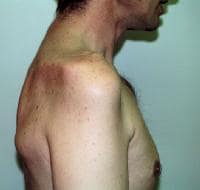
This isn't me... god please don't let this be me...


Speaking of the Doctor.  Wow, I felt so lucky!  I finally found a doctor that I really like.  I met with Dr. Karl N Kaluza on Wednesday.  I didn't realize this but this was his last day under Dr. Selby's roof.  He has left the practice to places unknown and the bitch of this is that Dr. Selby's office (for fear that I might jump ship) won't give me his forwarding information so that I can inquire about the diagnosis he delivered!   By the way, their fear is justified, I am tired of going to the Vicoden spiewing Dr. Selby.  All he does is write scripts for Vicoden and each time I tell him that I don't need it.  Haha, I got a vicoden sript for the flu! Note to all: Don't go see Dr. Selby.

Anyway, I finally find a Doctor that I really like and he has disapeared with all the answers to my questions!!! ARGUHHH!!!  MY MD IS MIA!!!

I was feeling so stir crazy today, I had to get something which might resemble a workout...  I hit the gym and decided that the pool would be the most gentil way of increasing my heart rate.  Here is the extent to what I was able to accomplish (by the way, I am happy about this - 5 days ago, I was bound to the couch in physical agony).

* 50 M Pool running
* 50 M Kick board (this hurt as I had to hold my head up out of the water)
* 50 M Pool running
* Hot tub therapy
* Steam room therapy

... Well... its better than nothing!